
Blog
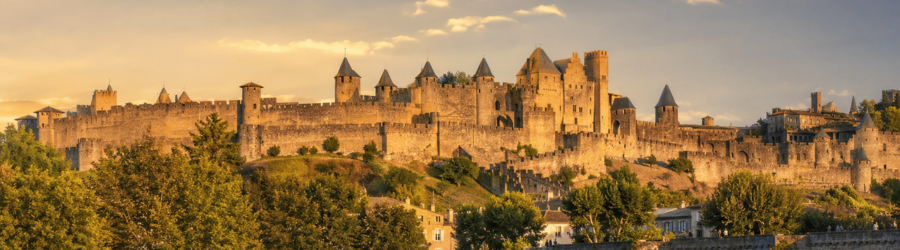
Visiting Carcassonne means exploring the largest fortified city in Europe, listed as a UNESCO World Heritage Site since 1997. Between its castle, its 3 kilometres of ramparts and the Canal du Midi, the town packs more than two thousand years of history into one place. A day in the medieval Cité and a half-day in the lower town are enough to see the essentials. To take your time in the region, an upscale campsite combines nature and comfort.
Here are seven sites not to miss.
Built in the 12th century by the Trencavel family, the Château comtal is the highlight of the paid visit. From its wall walk, the view stretches over the Aude valley and, on clear days, all the way to the Pyrenees. You cross the lices, the grassy passages laid out between the two walls, before reaching the rooms of the lapidary museum. This is where the military ingenuity of the fortress is best understood.
Visitors’ favourite: the wall walk and its dizzying view over the rooftops and the Aude countryside.
Practical information:
What strikes you immediately when visiting Carcassonne is this double belt of walls bristling with 52 towers. Almost 3 kilometres long, it layers Gallo-Roman and medieval fortifications with the 19th-century restorations of Viollet-le-Duc. The lices between the two enclosures can be walked on foot and tell the story of the evolution of defensive architecture. No other city in Europe preserves such a complete ensemble.
Visitors’ favourite: the stroll along the lices, between the two walls, away from the bustle.
Practical information:
In the south of the Cité, the Basilica of Saint-Nazaire blends Romanesque and Gothic styles, from the 11th to the 14th century. It houses some of the most beautiful stained glass in the south of France, which glows superbly at the end of the day. Medieval statues and an old organ complete the visit in a peaceful atmosphere. It is a moment of calm, away from the shopping streets.
Visitors’ favourite: the stained glass of the choir, lit up by the afternoon light.
Practical information:
Facing the main car park, the Porte Narbonnaise marks the most spectacular entrance to the Cité. Flanked by two massive spur-shaped towers, it once defended the eastern access to the fortress. Passing through it, you step straight into the medieval world, between bridge, portcullis and cobbled lanes. It is the natural starting point for any discovery of the Cité.
Visitors’ favourite: the view of the two spur towers, superb from the access bridge.
Practical information:
The visit is not limited to the Cité: the Bastide Saint-Louis, below it, deserves half a day. Founded in the 13th century during the reign of Saint Louis, this lower town follows a chequerboard plan inherited from the Middle Ages. Its shaded squares, its town houses and its covered market make for a livelier, more commercial atmosphere. Place Carnot, with its fountain and terraces, is the meeting point.
Visitors’ favourite: the market on Place Carnot, where producers gather several mornings a week.
Practical information:
Linking the lower town to the Cité since the 14th century, the Pont Vieux spans the Aude in a succession of stone arches. Reserved for pedestrians, it offers the most photographed view of the fortress on its hill. At sunset, the Cité stands out like a silhouette, gilded by the low light. It is a short but memorable stop between the two towns.
Visitors’ favourite: the Cité lit up in the evening, admired from the deck of the Pont Vieux.
Practical information:
Built in the 17th century by Pierre-Paul Riquet, the Canal du Midi runs through the lower town and is part of the UNESCO World Heritage Site. Its plane-tree-lined banks lend themselves to walking, cycling or a cruise through the locks. To visit Carcassonne differently, board a one-hour cruise or hire a bike along the towpaths. The coolness of the water contrasts with the warm stone of the Cité.
Visitors’ favourite: the bike ride to the locks, in the shade of century-old plane trees.
Practical information:
Where to stay to enjoy the ramparts, the castle and the banks of the Canal du Midi without giving up comfort? Discover our selection of upscale campsites in the Aude and book your base between pool, wellness area and medieval heritage, a few minutes from the Cathar city.


