
Blog
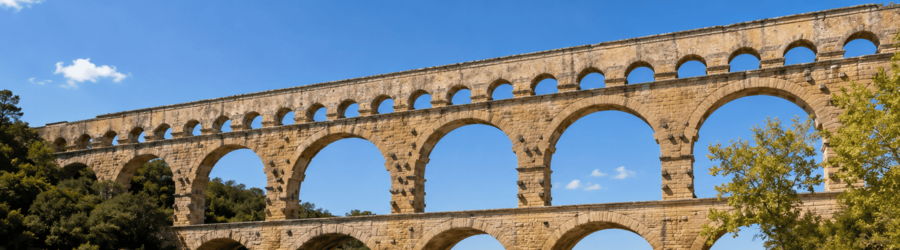
The Pont du Gard, the tallest surviving Roman aqueduct in the world, spans the Gardon at 49 metres in the Gard département. To discover it at your own pace from an upscale campsite, allow half a day. This ancient monument is a UNESCO World Heritage Site and welcomes more than a million visitors a year, between the structure itself, its museum, the natural beach and the garrigue trails. Here is the essential information for preparing your visit, from prices to activities.
The Pont du Gard forms the monumental section of an aqueduct designed to supply the Roman city of Nîmes with water. Two feats explain why its reputation has stayed intact for twenty centuries.
The aqueduct carried water over 52 kilometres, from the source of the Eure near Uzès to Nemausus, the ancient Nîmes. Along this entire route, the average gradient was only a few centimetres per kilometre. The Pont du Gard itself crosses the Gardon valley thanks to 3 superimposed tiers of arches, a masterpiece of balance and precision.
Built around 50 AD, the structure assembles limestone blocks, some of which weigh up to 6 tonnes, laid without any mortar at all. Standing 49 metres high and about 275 metres long, it remains the tallest surviving Roman bridge-aqueduct. Its UNESCO listing in 1985 secured its lasting protection. Our tip: come early in the morning or late in the afternoon. The low light then gilds the arches, and the crowds noticeably thin out. Buying your ticket online from €8 saves you time at the ticket desk. Also consider booking the right bank if you plan to swim in the Gardon afterwards.
Beyond the monument, the Pont du Gard site easily fills half a day. Several activities can be combined, most of them included in the entry ticket:
“Rent a canoe in the morning at Collias and let yourself drift right under the arches: it is the finest arrival possible at the Pont du Gard”, recommends our team.
To organise your trip, here is the useful information to know before visiting the Pont du Gard:
How can you enjoy the Roman aqueduct, the Gardon gorges and the garrigue without giving up comfort? Discover our selection of upscale campsites in the Gard and book your base a few minutes from the Pont du Gard, between pool and wellness area!
Entry to the Pont du Gard starts at €8 online and €9.50 on site. This price covers access to the site, the museum, the children’s areas and parking. Admission is free for under-18s.
Yes, swimming is possible at the Pont du Gard, on the natural beach of the Gardon’s right bank. It is practised in fine weather, without permanent lifeguard supervision. Stay cautious, as the level and current of the Gardon change with the seasons.
To visit the Pont du Gard, allow at least 1.5 hours for the monument and the museum. Half a day lets you add a swim, a canoe trip or a walk on the garrigue trails. In summer, come early to avoid the heat and the crowds.
Yes, the Pont du Gard is open all year, every day from 9 am. Closing times vary with the season, with later closing in summer. The museum follows slightly different opening hours depending on the period.