
guide
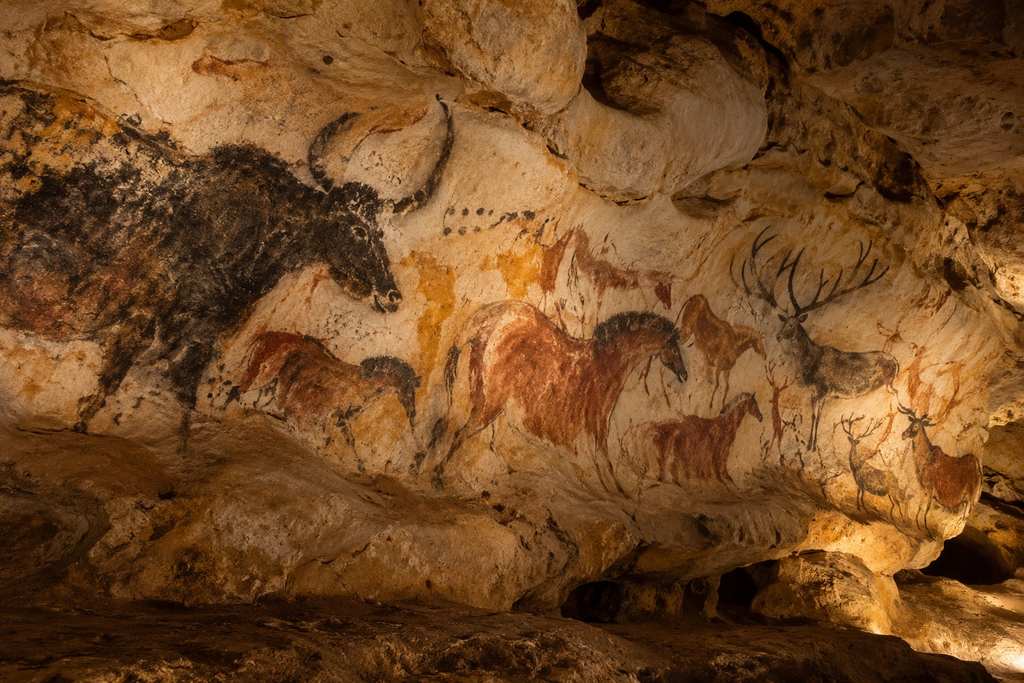
Bulls several metres long, horses, deer and mysterious signs painted thousands of years ago: the Lascaux cave, one of the most famous sites in France, is often called the “Sistine Chapel of prehistory”. Discovered in 1940 in Montignac, in the Dordogne, it was closed to the public as early as 1963 to save its paintings. Today it is discovered through remarkably precise replicas, including Lascaux IV, which welcomes more than 400,000 visitors a year. Here is its history, how to visit it and what to see around it in the Vézère valley.
On 8 September 1940, Marcel Ravidat, a young man from Montignac, followed his dog Robot and spotted a hole on the Lascaux hill. He came back on 12 September with three friends, Jacques Marsal, Georges Agniel and Simon Coencas: climbing down into the cavity, the four teenagers discovered walls covered in paintings. The news spread fast, and the cave opened to the public after the war. But the flood of visitors, with the heat, humidity and carbon dioxide they brought, threatened the paintings: the original cave was closed to the public in 1963 and has not been open since.
Lascaux has more than 600 painted and engraved figures from the Upper Palaeolithic, about 17,000 years old according to the Dordogne tourist office. The Hall of the Bulls, with its great aurochs, and the Axial Gallery, covered with horses and cows, are the most famous spaces. The artists used the relief of the rock to give the animals volume, and mineral pigments, ochres and oxides, for colour. In 1979, Lascaux was listed as a UNESCO World Heritage Site with the prehistoric sites and decorated caves of the Vézère valley, which has 147 sites and 25 decorated caves according to UNESCO.
The visit to the replica follows the layout of the original cave. After the Hall of the Bulls and the Axial Gallery come the Passage, the Apse, covered with hundreds of intertwined engravings, then the Nave, with the famous Black Cow, the Swimming Deer and the Crossed Bison. At the far end, the Shaft holds the only human figure in the cave: a bird-headed man facing a wounded bison, a scene whose meaning is still debated. The narrow Chamber of Felines closes the whole. These works, painted or engraved into the rock, show the mastery of the artists of the early Magdalenian.
Opened in Montignac in December 2016, the International Centre for Cave Art, known as Lascaux IV, houses the full replica of the cave. The tour covers 8,000 m² in six spaces: the facsimile, then a workshop and interactive galleries explaining Lascaux’s art and its place in history. Several options exist: the guided tour, morning and afternoon, a self-guided visit at lunchtime, a Prestige visit at specific times and a storytelling visit during school holidays. Allow 2.5 to 3 hours for a full visit. Tickets are booked online, on the official Lascaux IV website.
Opened in 1983 on the hill, just over a kilometre from Lascaux IV, Lascaux II reproduces the cave’s two most famous spaces: the Hall of the Bulls and the Axial Gallery. A pioneer among decorated cave replicas, it remains a moving visit for anyone who wants to see the paintings in a setting close to the original.
A visit to Lascaux IV works well as a family outing: the facsimile of the cave immerses children in the atmosphere of a real decorated cave, and the interactive spaces help them understand how the paintings were made. During school holidays, the storytelling visit tells the story of the Lascaux cave to the youngest. In Montignac, the visit can continue on the banks of the Vézère, then with a swim or a canoe trip in the valley. Remember to book the visit online and bring warm clothes for the facsimile.
Lascaux is not the only decorated cave in the valley. The UNESCO property brings together fifteen sites, including the Font-de-Gaume cave, the Combarelles cave and the Cro-Magnon shelter, in Les Eyzies. These original decorated caves, some still open to the public, are visited in small groups: book online well in advance. For a first discovery, the Lascaux replicas in Montignac remain the most accessible, then you can add an original site in the Vézère valley.
At the heart of the Périgord Noir, the Vézère valley holds one of the largest prehistoric ensembles in Europe. In Les Eyzies, the National Museum of Prehistory presents unique collections, and the Font-de-Gaume cave is one of the rare original decorated caves still open to the public, with limited places. In Rouffignac, the cave of the hundred mammoths is explored by small electric train. Along the river, La Roque Saint-Christophe and its troglodyte dwellings, the villages of Saint-Léon-sur-Vézère and Saint-Amand-de-Coly, and the Château de Losse round off the stay. In Thonac, near Montignac, the Parc du Thot shows animals close to those seen on the walls of Lascaux, a visit children enjoy after the cave. Montignac, with its half-timbered houses along the Vézère, is worth a stroll, and Sarlat-la-Canéda is only half an hour’s drive away.
Lascaux IV is open for much of the year, with opening times that vary by season. Summer is the busiest period in the Vézère valley: arrive early in Montignac and book your visit. Spring and autumn offer a calmer visit, with pleasant temperatures for exploring the Vézère valley by canoe or bike. During school holidays, the storytelling visit is a good idea with children.
Between Montignac and Sarlat, several upmarket campsites, including three five-star sites, combine indoor pools, wellness areas and comfortable accommodation, a quarter of an hour from the cave. Compare them in our selection of luxury campsites near Lascaux.


Campsites marked “Partner” are Aimer Camper members and are shown first. All results match your search.

