
Blog

The Alsace Wine Route stretches 170 km from Marlenheim in the north to Thann in the south. It passes through 119 wine villages growing the seven Alsatian grape varieties, from riesling to gewurztraminer. Created in 1953, it remains the oldest wine route in France. You will find flower-decked villages, grand cru vineyards, wine markets and rare architectural heritage.
Here you will find the itinerary, the must-see stops and tips to plan your stay at a luxury campsite.
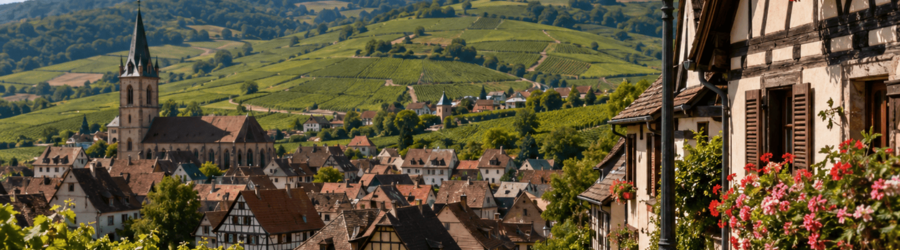
The Alsace Wine Route crosses two départements, the Bas-Rhin and the Haut-Rhin. It starts in Marlenheim, 20 km west of Strasbourg, then heads south to Thann. Over 170 km it follows the foothills of the Vosges, through forests, valleys and slopes devoted to vineyards.
The route is marked by distinctive brown signs. Along the way you pass fortified villages, medieval castles and signposted wine-route markers. According to the Conseil Interprofessionnel des Vins d’Alsace, the vineyard covers around 15,600 hectares, classified as AOC Alsace, AOC Alsace Grand Cru and Crémant d’Alsace.
The route suits several types of stay. You can drive it in two days for the main stops or spend a full week visiting estates, markets and heritage sites!
A dozen villages stand out as must-see stops on the Alsace Wine Route. All of them combine rare architectural heritage with a strong winemaking tradition. Here are the most visited, from north to south:
| Village | Main highlights |
| Obernai | Medieval ramparts, Place du Marché, view of Mont Sainte-Odile. |
| Mittelbergheim | Ranked among “the most beautiful villages in France”, Renaissance winegrowers’ houses. |
| Ribeauvillé | Three castles overlooking the town, Fête des Ménétriers in September. |
| Riquewihr | Well-preserved fortified town, tastings with historic winegrowers. |
| Kaysersberg | Voted “France’s favourite village”, half-timbered houses, fortified castle. |
| Eguisheim | Unique circular layout, Place du Château Saint-Léon, winegrowers’ markets. |
Each village can be explored on foot in a few hours. Vary the atmospheres. Obernai and Ribeauvillé are worth it for their ramparts. Riquewihr and Eguisheim stand out for their fortifications. Kaysersberg is distinguished by its river and its castle.
Our favourite: the cycle path between Bergheim and Riquewihr, about ten kilometres long. The route follows the foothills, crosses the vineyards on gentle slopes and offers wide views over the wine country. A break at the Hunawihr estate halfway along lets you catch your breath and discover a grand cru from the north of the Haut-Rhin. Ideal for a half-day.
Alsatian winemaking rests on 7 flagship grape varieties, each suited to the varied soils of the Vosges foothills. Here is what to know before visiting a cellar:
Beyond the classic varieties, the vineyard has 51 Grand Cru appellations spread across the most renowned terroirs, from the Bas-Rhin to the Haut-Rhin. To fully enjoy the experience, you have several options: visiting wine estates, wine markets (Ribeauvillé, Bergheim, Riquewihr, Mittelbergheim) and marked wine trails to walk.
The best period to travel the Alsace Wine Route runs from April to October. In spring you see the vines in blossom and the decorated villages. Summer brings wine markets, folk festivals and lively evenings. Autumn remains the highlight with the grape harvest.
In terms of transport, two options stand out. The car remains the most flexible choice, especially for linking distant villages. However, cycling is becoming increasingly popular. The vineyard cycle route (EuroVelo 5) stretches over 100 km and suits families too.
For accommodation, the upmarket campsite is a comfortable alternative to hotels and guesthouses. Discover our 4- and 5-star campsites in Bas-Rhin and our luxury campsites in Haut-Rhin to build your perfect itinerary.
Planning your getaway on the Alsace Wine Route? To enjoy the vineyards in the best conditions, choose accommodation that matches your stay!
To drive the Alsace Wine Route properly, allow at least 3 days for the main stops. A stay of 5 to 7 days leaves time to visit the villages and several wine estates and to enjoy Alsace’s gastronomic heritage at an unhurried pace.
Yes, the wine route suits family cycling. The vineyard cycle route (EuroVelo 5) offers a signposted track of over 100 km, with flat sections suitable for children. For easy stages, choose the sections between Obernai and Sélestat, or between Bergheim and Eguisheim.
The budget for a stay on the Alsace Wine Route depends on the length and type of accommodation. Allow around 80 to 150 € per night for an upmarket campsite pitch, and 30 to 50 € per person for a guided tasting at an estate. Bike hire costs about 20 € per day.
For a short visit to the Alsace Wine Route, we recommend Riquewihr, Eguisheim and Kaysersberg. These three villages are less than 20 km apart and cover the essentials: medieval architecture, preserved fortifications, renowned estates and gastronomic restaurants. You can see them on foot in a single day.
Yes, it is worth booking cellar visits along the Alsace Wine Route, especially in high season. Most large estates offer tastings by appointment, via their website or by phone. Independent wine cellars remain accessible without a booking, although the wait can be long in summer.